What is Virtual Reality? Virtual Reality is a set of computer technologies which, when combined, provide an interface to a computer-generated world, and in particular, provide such a convincing interface that the user believes he is actually in a three dimensional computer-generated world. This computer generated world may be a model of a real-world object, such as a house; it might be an abstract world that does not exist in a real sense but is understood by humans, such as a chemical molecule or a representation of a set of data; or it might be in a completely imaginary science fiction world.
A key feature is that the user believes that he is actually in this different world. A second key feature of Virtual Reality is that if the human moves his head, arms or legs, the shift of visual cues must be those he would expect in a real world. In other words, besides immersion, there must be navigation and interaction.
4. Medical applications of VR: a summary
Different kinds of VE technology support different modes of interaction.
Here follows a description of the typical hardware needed to run a virtual reality
system. It will later be discussed whether it's advisable to maintain all of these
components when trying to implement a VE on a PC. What is important here is to focus on a
standard architecture, as it is usually described in literature.
Virtual Reality is often used as comprehensive term to describe the use of 3-D graphics
displays to explore a computer generated world. This interaction between man and machine
can happen according to different styles that are representing the actual possibility and
potential of the technology. The different styles of interaction depend upon the way the
virtual environment is represented. We can identify at least six interaction styles that
refer to the way the simulated/virtual environment is represented: desktop, projected,
immersive, Cave, telepresence, augmented.
1) Desktop VR
The most popular type and is based upon the concept that the potential user interacts
with the computer screen without being fully immersed and surrounded by the
computer-generated environment. The feeling of subjective immersion can be improved
through stereoscopic vision (i.e., CrystalEyes) and operative action with interface can be
guaranteed via pointing devices (mouse, joystick) or typical VR peripherals such as
Dataglove. Desktop VR is used mainly in games but professional application are currently
widely diffused. Example of professional application domains come from general industrial
design, engineering, architecture and the visualisation of data streams. The main benefit
of desktop VR is its limited cost and less involving use of interacting technology, as a
matter of fact according to different scenarios of use it might be more appropriate a less
"invasive" device such as a CRT monitor than a wired HMD. It seems that desktop
VR is particularly successful with the inspection of sample objects as opposed to immersed
VR where the best exploitation is with the exploration of spaces. Up to date CAD/CAM
systems slowly shifted in their performance towards the quality of VR interaction when
they allowed the user to manipulate 3-d objects as if they were real.
2) Projected VR
This is technological solution often seen in VR-Art shows and in VR leisure
applications. It is based upon the overlapping of the image of the real user on the
computer generated world. That is to say that the user can see his image overlaid the
simulated environment. A special movement tracking device can capture the movements of the
user and insert them so that they can cause actions and re-actions in the virtual world.
3) Immersive VR
With this type of solution the user appears to be fully inserted in the computer
generated environment. This illusion is rendered by providing HMD, with 3-D viewing and a
system of head tracking to guarantee the exact correspondence and co-ordination of user's
movements with the fee-back of the environment.
4) CAVE
Cave is a small room where a computer generated world is projected on the walls. The
projection is made on both front and side walls. This solution is particularly suitable
for collective VR experience because it allows different people to share the same
experience at the same time. It seems that this technological solution is particularly
appropriate for cockpit simulations as it allows the views from different sides of a
imaginary vehicle.
5) Telepresence
Users can influence and operate in a world that is real but in a different location. The users can observe the current situation with remote cameras and achieve actions via robotic and electronic arms. Telepresence is used for remote surgical operations and for the exploration/manipulation of hazardous environments (i.e., space, underwater, radioactive.
Virtual Reality is the product of a trick. The VR system tricks the user into believing that the Virtual Environment by which he feels himself surrounded is the actual, real environment. This is made possible by several different devices, each with its own technology, which produce each a specific aspect of the VE, relevant for a specific sense. We will discuss hardware relevant for the three senses which are to be immersed in the VE: sight, touch and hearing.
6) Augmented
This VR solution is an invasive strategy towards reality. As a matter of fact user's view of the world is supplemented with virtual objects and items whose meaning is aimed at enriching the information content of the real environment. In military applications for instance vision performance is enhanced by providing the pictograms that anticipate the presence of other entities out of sight.
In the Information Technology trend, Virtual Reality has been identified as one of the most promising development areas. As it happens with all the innovative applications this new technology is not excluded from the generation of problems and concerns regarding its implementation in operative working domains. Yet we are witnessing a constant improvement in marketing perspective of both quality of applicative VR systems and receptiveness of potential customers. This is due to mainly three reasons: (1) the decrease of the cost of VR systems and devices (2) the constant improvement of performance reliability of the technology, (3) the extremely valuable economic benefits derived from VR use in its various forms and purposes (training, simulation, design). So we can affirm the consolidation of a class of technology that can positively be stated as "virtual reality" and appraised like any other novel high tech industry. This technology has been confidently adopted in a number of markets, and has the potential to penetrate in many more.
The VR market is at present immature, without any clear market leaders or clear
segmentation of activities. In a recent paper prepared for the European Commission's IT
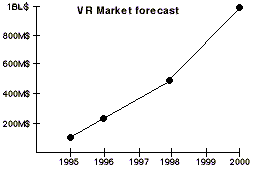
Policy Analysis Unit (DG III/A.5) on VR, PVN (Belgium) estimates a market of $570 million
(MECU 483) by 1998. This figure includes both hardware and software. The bad news for
Europe is that it is forecast to have only $115 million (MECU 97) of that market, a poor
third behind the USA and Japan.
A study into telematics applications of virtual environments, carried out by Sema Group
(F), Fraunhofer IAO (D) and MIT's Research Laboratory for Electronics (USA) for the
Commission's DG XIII/C in 1994, predicted a market evaluation of "roughly MECU 400 -
MECU 500 by 1998" with a growth rate "very high, approaching 70-80% per
year". What is perhaps less disputed is that the major market activity is in
entertainment equipment.
Frost & Sullivan's 1994 VR market report stated that about 250 companies existed in the USA and only 25 in other countries which claim to make even part of their revenue from VR. Of these, no one firm earned more than $10 million (MECU 8.4) from VR alone. A recent Financial Times Report listed four types of commercial VR company - software companies, component manufacturers, system companies and 'other industry participants'. As might be expected, the vast majority of such companies are US-based. Only two European company, Superscape and Division of the UK, is listed under software companies and only one European Company, Virtuality, is listed under component manufacturers.
Although this listing was not ranked and was definitely not exhaustive, most
activity does seem to be taking place in the USA. The wider availability of venture
capital and the tendency of small firms to 'spin off' from others may account in part for
this.
According to the recent (Jan. 96) Business Communications Company, Inc. report
"RGB-175/The Virtual Reality Business", by 1996, more than 300 companies will
settle sales for about $255 million worth of VR products and services and behind this
figures lay as VR customers many multinational brands of military and medical products. By
2000, the VR industry will be posting annual sales of over $1 billion and reaching an
annual average growth rate (MGR) of 33%.
In July of 1996 Ovum, the UK market research company published another survey on Virtual
Reality (VR) markets: 'Virtual Reality: Business Applications, Markets and Opportunities.
Ovum expects the 'killer application' of VR to be in 3D interfaces to the Internet,
used for promoting products and services on the World Wide Web (WWW). It predicts that in
the next five years, VR will be widely used as a GUI (graphical user interface) for
standard business software, thus replacing icon-based GUIs for such applications as
database, business systems and networked management software. According to the survey, a
large proportion of companies polled indicated that they would use PC based VR training
applications for their employees.
Regarding the present uptake of VR in business, the report concludes that ?companies
are finding virtual reality an important source of competitive advantage? and that
?although some companies are taking their time to evaluate VR, which is slowing down the
speed of market lift-off, many are reporting significant benefits and are increasing
their use of VR technology.? It explains this expected increase in uptake by saying
that ?In many cases, companies have made cost savings of over US$1 million. They
have experienced faster time to market, fewer mistakes than when using CAD technologies,
greater efficiency in working methods and improved quality in final products.?
The report predicts that the VR market will grow from US$134.9 million in 1995 to just
over US$1 billion by the year 2001 and that the largest growth sector will be in the
software sector with a 58 per cent annual growth in this period.
Another significant finding of the report is that the business market for VR in 1995
represented 65 per cent of the total, with entertainment applications accounting for only
35 per cent. VR is normally seen to be of major significance to the games market?. it is
not known whether, and how, the authors distinguish between entertainment and ?the
entertainment business?.
The Ovum survey foresees a radical shift in how companies will be using VR between now and
the year 2001. Today the majority of VR applications are in design automation: virtual
prototyping, interior design and ergonomics, and architectural and engineering design.
Expensive, workstation-based systems currently dominate, accounting for 43 per cent of the
market. By 2001, however, PC-based VR technology will account for 46 per cent of the
business market, where most of the applications will be non-immersive, using computer
screens instead of headsets.
Virtual Reality Market Forecasts by Application ($ millions, constant 1995 )
| 1994 | 1995 | 2000 | AAGR% 1995-2000 | |
| Instructional & Developmental | 70 | 95 | 355 | 31 |
| Design & Development VR | 25 | 30 | 150 | 40 |
| Entertainment VR | 60 | 110 | 500 | 35 |
| Medical Treatment VR | 10 | 20 | 50 | 20 |
| Total | 165 | 255 | 1055 | 33 |
| Source: Business Communications Company, Inc., GB-175, The Virtual Reality Business, 1996 | ||||
Applicative domains and major marketing areas
At the current state of the situation all marketing experts converge on the fact that the major market activity is entertainment equipment: leisure technology uses account for the largest VR market value, and are foreseen to continue growing at a 35% AAGR to the year 2000 (see table). The critical mass in marketing terms will be reached with high-scale produced single-user entertainment VR system, this will be the propelling force pushing the market growth from a current 1995 value of $110 million to $500 million by year 2000.
Home and entertainment
The great market expansion is expect for site- based entertainment. This expectation is
based upon the evaluation two factors: the low saturation, and dramatic decrease of
prices. This phenomena will allow VR technology to be used by all facets of society,
including commercial/industrial, the government, military, and university and secondary
schools at a stage not comparable with any previous existing situation. A great role will
also be covered with in the support to education in general, for instance the
instructional and developmental market is expected to widen its share from a $95 million
1995 market figure to $355 million by 2000, resulting in an AAGR of 31%. The dimension of
this increase will affect technical/engineering colleges and universities, and the
"developmental" VR includes spending on advanced, but as yet non-commercial
applications, along with pure science and research systems not included in the other
categories.
Industrial and Scientific Design
Applications of design and development VR market are in engineering, architecture and chemical design and development a constant shift will bring performance of CAD/ CAMM application to the standards of Virtual Reality applications . This market will grow from a 1995 market value of $30 million, to $150 million by 2000, reaching an AAGR of 40%. Medical treatment VR market will also sustain growth. The 1995 market value of $20 million is projected to reach $50 million by 2000, reaching a 20% AAGR.
The searching for common standards
Current VR products employ proprietary hardware and software. There is little doubt that incompatibility between different systems is restricting market growth at present. It is probable that as the market matures, certain de facto standards will emerge, perhaps when major players become involved. It is probable that the VR market will follow the route of the real-time financial information markets which found that adopting an open systems approach did not damage sales, as had been feared, but helped encourage the growth of the marketplace. According to the IMO - Information Group at Policy Studies Institute, London (August 95 - VIRTUAL REALITY: THE TECHNOLOGY AND ITS APPLICATIONS), "in the future an open systems approach will emerge for VR as well". At that point, the market is likely to expand considerably.
However, the cost of VR equipment is falling rapidly. For example, headgear prices have already fallen from hundreds of thousands of dollars to $200 (ECU 169), and basic VR software packages are available commercially for $100 (ECU 85), or can be downloaded from the Internet. Simple VR games software is available in the USA for $70 (ECU 59).
The seminal efforts that gave rise to VR took place in the US. Funding from EC organisations has been slower in coming than in the US, where the Office of Naval Research, National Science Foundation, and Advanced Research Projects Agency now fund VR research and the National Aeronautics and Space Administration has been a long-time developer. This situation is perhaps attributable to the large cost associated with VR until quite recently. However the importance of VR is clearly understood in Europe and progress is now going forward across the entire spectrum of virtual reality, with special emphasis on industrial and commercial applications.
Europe encompasses various countries and cultures, and acceptance of the importance of VR has not been uniform. Interest by British Aerospace, the presence of the parallel processing company Inmos (makers of the Transputer), and early funding by the Department for Trade and Industry are cited by UK researchers as factors that drove research in the UK in the mid-to-late 1980s. This resulted in technology transfer that has produced several successful commercial efforts. More recently, German laboratories and institutions have become active in applying immersion technology to a broad range of applications. France has several of Europe's leading research institutions for machine vision, robotics, and related technologies that affect VR, but has been less active in developing systems that provide interactive immersion. Most other West European countries have some VR R&D.
In the last two years, the EC organised several events to evaluate VR as a topic for the next research initiative. Recently EC presented one study titled: "Telematics applications of VE - The use of Virtual Environment Techniques in the Application of Telematics to Health Care, Transport, Training and the Disabled and Elderly". This study was the third activity in a row starting with a workshop in March 1993 in Brussels in which was tried to make some kind of a status report and start the process of gathering recommendations on how to incorporate VR in future EC programmes. The second activity was a small report creating the basis for a larger study, which finally was carried out by a team from Fraunhofer Institute, SEMA Group and MIT.
The "Telematics Application" shows a small section on VE technologies, VE applications (generic use of VE technological capabilities, evaluation of the market) and treats then each of the mentioned fields (Education/Training, Transport, Health Care, and Elderly and Handicapped) and finishes of with potential actions for the TAP programme. In the health area the reports states: "In effect, the objective is to validate the 3-D approaches of VE, and evaluate their benefits for future health care systems. In parallel, other projects aimed at providing basic building blocks for future uses in VE- based medical applications are also of interest. They concern digital and computational models of the human body or critical organs". The report stresses the use of VE in minimally invasive surgery, surgical decision support and training of surgeons, doctors and students. It also finds a use in evaluation of human interfaces and other factors in the design of critical components of new health care facilities.
EC funded projects/working groups relevant to VREPAR
The European Strategic Program for Research and Development (Esprit II) funded a handful of ongoing VR projects. Glad-in-Art is developing a glove-exoskeleton interface system to manipulate virtual objects, while SCATIS intends to integrate room acoustics into virtual worlds, and Humanoid concentrates on the development and simulation of virtual humans.
The call for proposals for Esprit III did not include a specific VR component. However, VR was explicitly mentioned within the basic research and multimedia components (two of the seven program areas). Between the funded studies we remember FIVE (Framework for Immersive Virtual Environments).
Other VR projects deal with Virtual Environment on Multi-Modal Interfaces (MIAMI and
VETIR). VETIR deals with the use of virtual environment technologies in motor
disabilities' rehabilitation technology Initiative for Disabled and Elderly People.
Three important aspects of virtual reality systems offer new possibilities to medical
treatment:
According to an assessment on current diffusion of VR in the medical sector, gathered
by the Gartner Group, forecast of VR future in this area are quite promising.
Within the medical application its strategic relevance will increase and gain importance.
It is envisaged that by year 2000 despite possible technological barriers, virtual reality
techniques will be integrated in endoscopic surgical procedures. VR will affect also the
medical educational strategy for students as well as experienced practitioners, who will
increasingly be involved in immersive simulated techniques. It is expected that these
educational routines can become of routine by year 2005.
VR has been until now widely underused, probably because of prohibitive hardware costs,
nevertheless this technology is pushing forward new challenges and advances that will
materialise by year 2000. The medical use of VR will take place mainly in four domains:
For a more detailed description of the use of VR in health care you can read the paper: VR in Health Care: A Survey
5. Issues to be solved
Although the technology is mature enough to have different applications, there are key issues to be resolved for its use for practical applications.
The marketing situation of VR is very fluid, this means that the technology while being
ready for professional applications is not at the stage of settling definite standards and
definite reference points in all perspectives, including possible leading manufacturers,
compatibility specifications, performance levels, economical costs and human expertise. So
standing the situation it is heavily characterised by uncertainty.
This uncertainty should not be confused with lack of confidence on the promising outcomes of the technology, but instead with the rapid mutation and evolution that characterises all information technology markets. For what concerns the project these reflections sound as warning in the adoption of solutions that need to be considered as a short term answer to a contingent problem. A special concern must be raised to a continuos chase of the last up to date technological product release.
In the general aim of the project we take advantage of the capillary diffusion of the PC based technology and to the best associated hardware and software devices available that can ensure both reliability and availability in different domains independently of the different constraints posed by geographical location.
For any questions or requests, please contact auxo.psylab@auxologico.it